What Is Business Forecasting and Why Is It Crucial to Your Company?
In this article:
What if you had a crystal ball, an insight into the very heart of the future, one that could direct you toward success?
Of course, no one can predict the future, but with powerful and detailed business forecasting, you can be prepared to plan and pivot. This is crucial when the health of your company is at stake.
But what is business forecasting, and why is it so essential? It’s not a crystal ball, but it’s a powerful tool that your business can’t afford to ignore.
At CAP3 | Reveal, we know that the unknown can cause stress, and that makes it difficult to make decisions with clarity and focus. Our business forecasting services provide detailed analytics that include trends and project revenue—we’ll even review various scenarios to ensure you’ll be prepared. We’d love to learn more about you and your company. Remember: You don’t have to go it alone. Contact us and see why we’re not just mere vendors; we’re your partners.
In this article, we’ll take a closer look at what business forecasting is and answer some of the most frequently asked questions we receive.
What Is Business Forecasting?
While business forecasting can’t predict the future, it can help you make informed decisions. Business forecasting implements data, projections, business metrics, industry changes and the economy to develop a well-rounded strategy to help steer the ship.
While forecasts are essentially informed “guesses,” good ones are backed by data that includes multiple variables and scenarios. The ultimate goal is to prepare you—not predict—various situations.
What Financial Factors Can Be Predicted With Business Forecasting?
A solid business forecasting plan takes into account several data points, helping aid in predictions that include:
- Sales
- Revenue
- Macro and microeconomic factors
- Growth
- Competition
- Inventory
- Production capacity
- Financial statements, including:
- Capital allocation
- Staffing
- Inventory
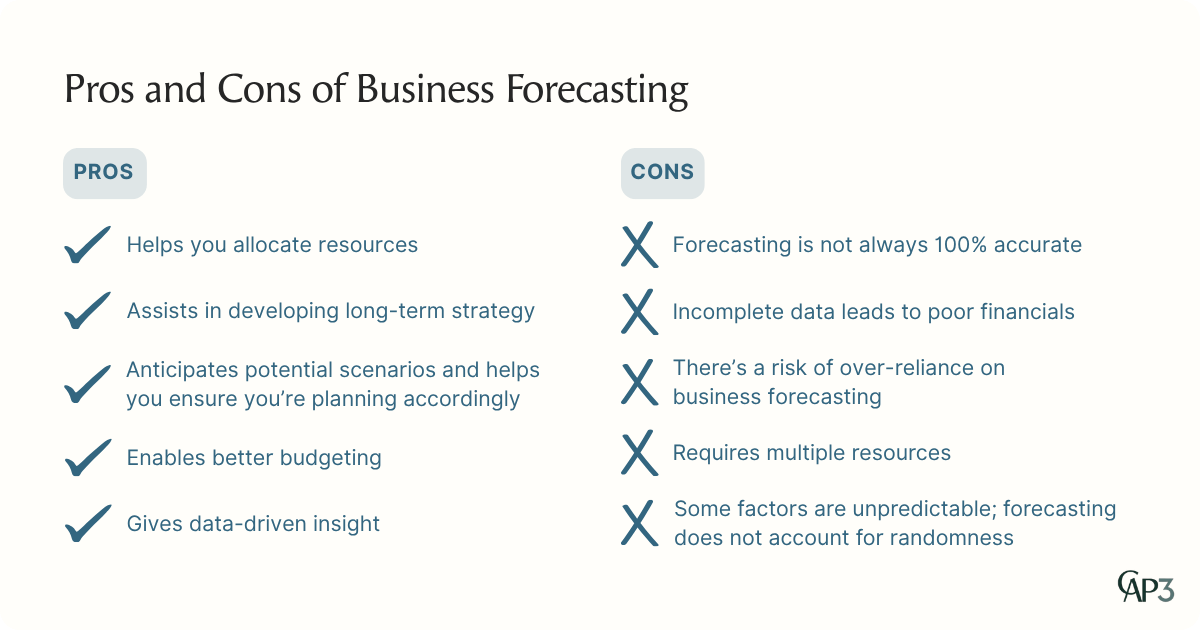
What Are the Pros and Cons of Business Forecasting?
When business forecasting is done correctly, it’s a great benefit to your company and your overall marketing and development strategy.
However, it’s important to note that business forecasting can have a few drawbacks.
What’s the Difference Between Qualitative vs. Quantitative Business Forecasting?
Qualitative Forecasting
The main features of qualitative forecasting are that it relies upon:
- Expert opinions and educated judgment
- Extensive market research
Therefore, you could consider it as providing more “soft” and generalized insights. It’s less reliable than methods that are backed by more data, but it can be useful when working with situations where data is not always complete (or reliable).
Quantitative Forecasting
The main features of quantitative forecasting are:
- Reliability on “hard” data—mathematical models, statistics and historical data
- It’s best used for long-term forecasts
- It’s less biased than qualitative forecasting
At CAP3 | Reveal, we use a combination of both quantitative and qualitative forecasting. We combine an analysis of historical quantitative data, cost of capital, growth goals, owner/leader intuition, understanding of competitive pressures and industry opportunities. Combined, these provide clarity to provide decisive direction.
Is Business Forecasting Always Accurate?
As we mentioned earlier, business forecasting is not a crystal ball, so it cannot predict the future with 100% accuracy. However, what it can do is provide “what if” scenario planning. This can help prepare for the unexpected.
Be Prepared: Let Our Business Forecasting Services Provide Clarity and Focus
While no one can predict the future, educated scenario planning and preparation will go a long way toward maximizing benefits and minimizing risk. Business forecasting should play a critical role in your organization.
At CAP3 | Reveal, we want to provide the context, focus and clarity to enable you to lead. Through our business forecasting and a host of other financial services, we want to be more than a vendor. We want to partner with you. Just contact us to start the conversation.
Key Takeaways:
- Business forecasting is a data-driven tool that helps businesses prepare for future scenarios rather than predict them.
- It combines financial data, industry trends, and economic factors to support strategic decision-making.
- Forecasting can estimate sales, revenue, growth, competition, inventory, production capacity, and other financial metrics.
- The benefits of forecasting include resource allocation, long-term strategy development, budgeting, and data-driven insights.
- Limitations include potential inaccuracy, incomplete data, unpredictable factors, and resource requirements.
- Qualitative forecasting relies on expert opinions and market research for “soft” insights, especially when data is limited.
- Quantitative forecasting uses historical data, statistical models, and mathematical analysis for more reliable long-term projections.
- Business forecasting is never 100% accurate, but scenario planning helps prepare for unexpected challenges.
- Effective forecasting provides clarity and focus, enabling businesses to make informed decisions with confidence.
- CAP3 | Reveal offers business forecasting services that guide companies through scenario planning and strategy execution.
=====
Sources:
Beattie, Andrew, “What Is Business Forecasting? Definition, Methods, and Model,” Investopedia, https://www.investopedia.com/articles/financial-theory/11/basics-business-forcasting.asp